Mobile banking is no longer just a channel; it is the bank. In 2025-26, customers don’t compare you to other banks- they compare you to Uber and Spotify. They expect instant onboarding, biometric security, and hyper-personalization. To meet these expectations, banks are turning to unified digital banking platforms (like Appzillon) to deliver secure, scalable experiences quickly.
For bank CIOs and Product Heads, the challenge isn’t just “building an app.” It is navigating the complex trade-off between speed-to-market, compliance (RBI, NIST, PCI DSS), and development costs.
This guide breaks down the realistic architecture, security frameworks, and most importantly, the actual cost and timeline models to launch a scalable mobile banking app in 2026.
The Cost & Timeline Table for Mobile Banking Solutions
| Approach | Typical Time to MVP | Relative Cost Level (2025-26) | Key Cost Drivers You Control | Best Fit |
|---|---|---|---|---|
| Fully Custom Development | 12–24 months | ★★★★★ (Highest) |
Team size, geography, custom integrations | Tier-1 banks with very unique needs |
| Customizable Modules | 10–18 months | ★★★★☆ | Fixed-scope contracts, change requests | Legacy migrations |
| Standard Low-Code | 3–8 months | ★★★☆☆ (40–70% lower than custom) |
Number of pre-built journeys used, internal vs partner delivery | 95% of mid/large banks & Credit Unions |
| Pure No-Code SaaS Tools | 2–5 months | ★★☆☆☆ (Lowest upfront) |
Subscription + vendor lock-in, limited scale | Startups only |
The Hidden Costs of Build vs. Buy
When calculating the cost of mobile banking app development, many CIOs overlook the Total Cost of Ownership (TCO). A custom-coded app requires a permanent team for iOS updates, security patches, and OS upgrades.
In contrast, a platform like Appzillon amortizes these maintenance costs. When Apple releases a new iOS update, the platform handles the compatibility, saving the bank approximately 30% in annual maintenance opex.
Pro Tip: In 2026, the industry is shifting toward pre-built mobile banking solutions and Low-Code platforms (like i-exceed’s Appzillon). This approach balances the customizability of bespoke code with the speed of off-the-shelf SaaS.
Architecture Blueprint: Secure and Scalable by Design
Modern apps don’t exist in a silo; they are extensions of a broader digital banking platforms. To survive the current threat landscape, your architecture must be secure by design.
- Client Apps (Android & iOS): Request minimal permissions. Enforce TLS 1.3.
- Identity & Access: strict implementation of OIDC with PKCE and device-bound tokens.
- API Layer: Secure APIs with OAuth2, consent management, and strict rate limiting.
- Governance: Alignment with RBI Master Directions (for India) or NIST/GDPR (Global) is non-negotiable.

The Recommended Tech Stack for 2026
Choosing the right technology determines your app’s scalability. While legacy banks rely on monolithic structures, modern development demands a composable approach for Mobile Banking App Development.
1. Frontend: The Shift to Cross-Platform (Flutter)
- The Landscape: Traditionally, banks built two separate native apps—Swift for iOS and Kotlin for Android. While this offers high performance, it doubles the mobile banking development cost and maintenance efforts.
- Our Recommendation: For 2026, we recommend a Flutter-based banking app architecture. A common question we hear is, "Is Flutter secure for enterprise banking?" The answer is yes. Unlike older hybrid frameworks, Flutter compiles to native code, offering the security and performance of a native app while allowing you to deploy a single codebase across all channels.
2. Backend: Enterprise Stability (Java Microservices)
- The Landscape: Trendy lightweight languages like Node.js are popular for startups, but they often struggle with the complex concurrency required in financial systems.
- Our Recommendation: For mission-critical infrastructure, Java microservices for fintech remain the gold standard. Java offers unmatched thread safety and a mature ecosystem (like Spring Boot) that simplifies regulatory compliance. A secure microservices architecture allows you to scale specific high-traffic modules—like UPI or Payments—independently without re-deploying the entire monolith.
3. Database: The "Polyglot" Advantage (Oracle & PostgreSQL)
- The Landscape: There is often a debate regarding Oracle vs PostgreSQL for banking and which handles transactional loads better.
- Our Recommendation: We advocate for a hybrid approach that uses the right tool for the job.
- Oracle: Ideal for the core ledger and high-value transactional integrity where ACID compliance is non-negotiable.
- PostgreSQL: The best choice for modern, cloud-native services. It effectively handles unstructured data (JSON) and is perfect for scalable fintech database requirements, significantly reducing licensing overhead for non-core microservices.
Step-by-Step Development Roadmap
-
Phase 1: Discovery & Planning (2–4 weeks)
Owner: Product Owner + Business Analyst
Define objectives, compliance scope, and user journeys. -
Phase 2: UX/UI Design (3–5 weeks)
Owner: Design Lead
Create wireframes and prototypes; validate with stakeholders. -
Phase 3: Development (8–16 weeks)
Owner: Engineering Manager
Build MVP with secure architecture and API integrations. -
Phase 4: Testing & Compliance (4–6 weeks)
Owner: QA Lead + Security Team
Perform functional, security, and compliance checks. -
Phase 5: Launch & Support (Ongoing)
Owner: Product Owner + DevOps
Deploy, monitor, and update continuously.
Security & Compliance Essentials
- OWASP MASVS: Mobile security baseline for authentication, storage, crypto, and privacy.
- NIST SP 800-124r2: Secure mobile device lifecycle management.
- PCI DSS v4.0.1: Strong MFA and payment integrity checks.
- Regulatory Specifics: For Indian markets, adherence to RBI’s Digital Payment Security Controls regarding VAPT cadence and API security is mandatory.
Developer Best Practices
- Never hard-code credentials; use secure storage.
- Encrypt sensitive data at rest and in transit.
- Automate VA/PT and integrate security checks into CI/CD.
- Use OWASP MASTG for testing and publish SBOMs for transparency.
Banking Strategy: Beyond Technology
- Personalization: Offer contextual nudges and financial advice.
- Embedded Finance: Integrate APIs for partnerships and new revenue streams.
- Payments: Optimize in-app and wallet experiences while maintaining PCI DSS compliance.
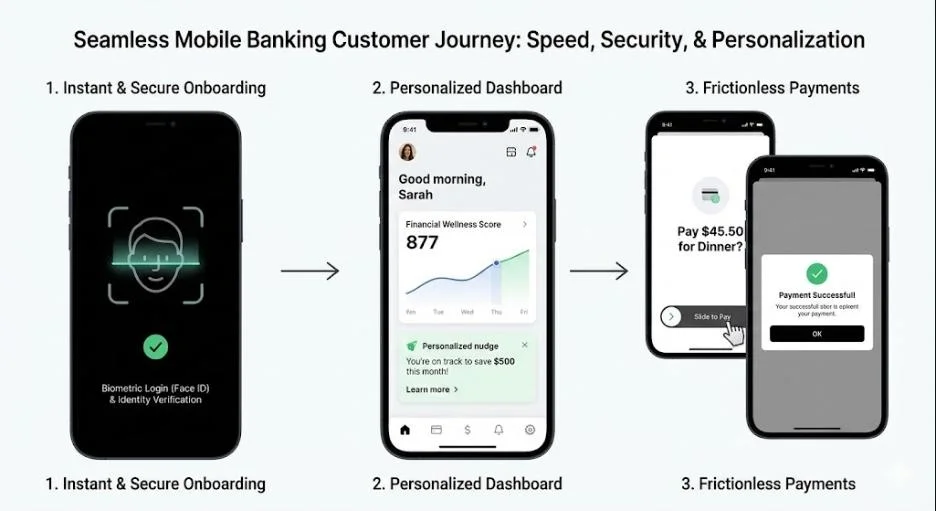
The New Standard: Modern banking apps must evolve from simple transactional tools to personalized financial advisors. This storyboard illustrates the shift toward biometric security and AI-driven insights.
Must-Have Features for 2026:
- Biometrics: FaceID/Fingerprint for login and transaction approval.
- Split Payments: P2P integration for shared expenses.
- Virtual Cards: Instant digital card issuance while waiting for physical plastic.
How Appzillon Helps Banks Win
Appzillon, i-exceed’s unified digital banking platform, accelerates secure mobile banking solution development and omnichannel experiences:
- Speed to Market: Low-code accelerators and pre-built journeys reduce development time.
- Security by Design: Built to align with OWASP MASVS and integrates DevSecOps for continuous compliance.
- Omnichannel Consistency: Unified design system ensures seamless experiences across mobile, web, and branch.
- API Readiness: Simplifies integration with core banking and fintech partners while enforcing governance.
- Compliance Enablement: Supports RBI, NIST, PCI DSS, and ISO 27001 requirements with audit-ready evidence.
The RFP Checklist: 10 Questions to Ask Vendors
Don’t sign a contract for a mobile banking application development until you get clear answers to these 10 questions:
- Compliance: Do you have documented compliance with OWASP MASVS and PCI DSS v4.0.1?
- VAPT: What is your cadence for Vulnerability Assessment (VAPT) and your remediation SLAs?
- Supply Chain: Do you provide SBOMs to track and monitor third-party vulnerabilities?
- Consistency: Does your platform support real-time state synchronization between web and mobile channels?
- Response: What is your SLA for delivering critical security patches?
- API Governance: How do you handle OAuth2, consent management, throttling, and rate limiting?
- DevSecOps: Is security testing (SAST/DAST) fully automated within your CI/CD pipelines?
- Auth: Do you support passkeys and risk-based multi-factor authentication (MFA)?
- Data Residency: How do you manage cloud data residency and compliance with standards such as ISO 27001 and SOC 2?
- Proof: Can you share region-specific banking case studies demonstrating regulatory alignment?